project begin date: March 07, 2021
project end date: Indefinite
completion rate: 80%
success rate: 70%
remarks: work in progress
1. Intro
I began actively working on ways to improve my memory when I realized I couldn’t learn anything properly and longterm without a kind of external structure—somewhere to “put” the many concepts I was learning, and something to help revisit them. The precise history of events escape me but reading Andy Matuschak’s article inspired me to actually begin work on the project I had been postponing.
The concept of human memory augmentation is a very broad and interesting one. Methods for improving memory can be medical as with the use of Nootropics. Or creative as with the use of Mnemonics. Or even technological as with the use of systems that afford spaced repetition. The methods are various and the history is rich.
The history of improving memory with technology goes back a long way. From Douglas Engelbart in Augmenting Human Intellect (1962) to Ted Nelson in Complex information processing: a file structure for the complex, the changing and the indeterminate (1965) to Tim Berners-Lee in Information Management: a Proposal (1989) to Piotr Wozniak and so on. If interested in a brief overview of this history, read Michael Nielsen’s big and brilliant essay, Augmenting Long-term Memory
What is Spaced Repetition?
Modern personal memory systems exploit the fact that if a piece of information is assimilated and then periodically retrieved/recalled at expanding intervals, then that information is likely to be assimilated for long-term, spanning years. This ‘process’ of ‘recalling at ever expanding intervals’ is termed spaced repetition. See Spaced Repetition for Efficient Learning by Gwern for an indepth and almost academic look into the concept—The essayish article is also as briglliant as Michael Nielsen’s.
This particular ‘essay’, on the other hand, is an index into the various thoughts I had while involved with the project of exploiting this fact. It should not be read as a thorough guide but a personal and impressionistic take (and experiment) on SRS systems.
There are now many technologies (apps and softwares and routines) that seriously expand on the idea of spaced repetition. One of them is Anki. It is an app. There is a mobile version and a desktop version. Another is Orbit currently in development by Andy Matuschak. This will really bring about big and important changes to the SRS space. Yet another is Space, Mnemosyne, SuperMemo, and so on.
For various reasons that will be explained in this essay, I chose to work with Anki—The mobile and desktop client.
What is Anki?
Anki is basically a todo-app on steroids. This, though, is an oversimplification. Anki helps schedule ‘tasks’ which are displayed as flashcards to the user. A task in this sense is the actual act of repeatedly recalling something. If, for example, you need to remember the name of an obscure animal you just discovered, you can create a ‘task’ that has a picture of the animal and regularly asks you—daily or weekly or specified by some deterministic formula—what its name is. Your job then is to provide the name by trying to recall it. A task is not limited to recall though. It could be a physical action you must perform such as an exercise. (We want to think about the concept of SRS systems unrestrictedly)
Project’s Aims
- Master using SRS (aka. Anki) to remember bits of information;
- Improve speed of recall;
- Actively keep track of thoughts;
- Learn how to think about a good number of chunked information simultaneously so that relationships between the various information can be easily drawn-out;
- Use SRS to help make it easier to take-up MOOCs;
- Make subject of learning integral to one’s personality;
- Gain introductory experience behind the basic insights that the field (Memory Augmentation with Technology) builds upon.
(It is important to note that the bulk of work on this project was actually in the observation of my ‘user-experience’ while learning a few topics through various information media, saving created prompts (for the media) to Anki, and noticing what could be done for a better streamlined experience. This is not an actual Design Project because specific research, conception, prototyping and engineering of some proposed SRS was never carried out. The outcome of the project is chiefly an introductory experience of the basic insights/principles that the field of Memory Augmentation builds upon)
2. How I use Anki
When you newly install the Anki desktop client, this is what you see:
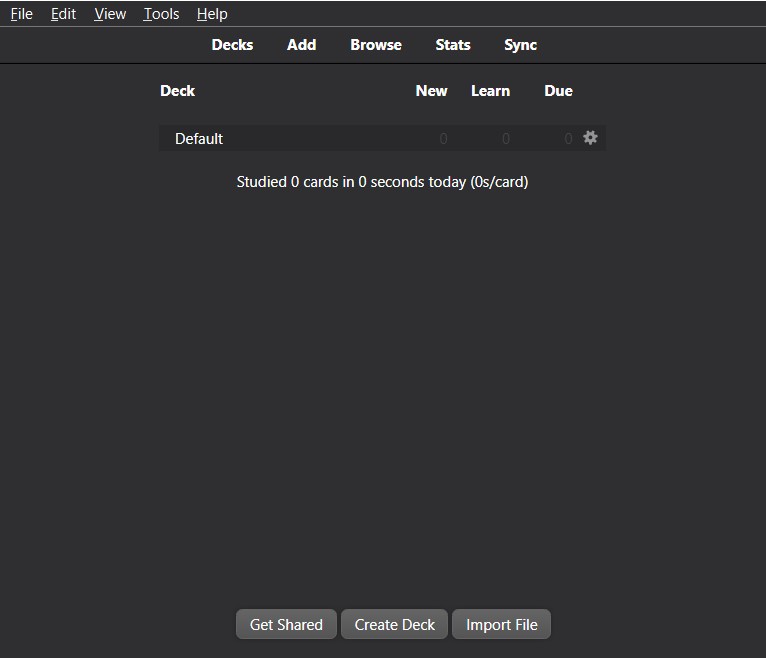
The decks are like folders you use to separate groups of notes. In the image above, there is one deck and it is the ‘default’ deck.
A note is basically a question and answer pair. You provide both the question and the answer where, during review sessions, the answer is hidden and you are meant to recall it.
You provide a question. Like so:
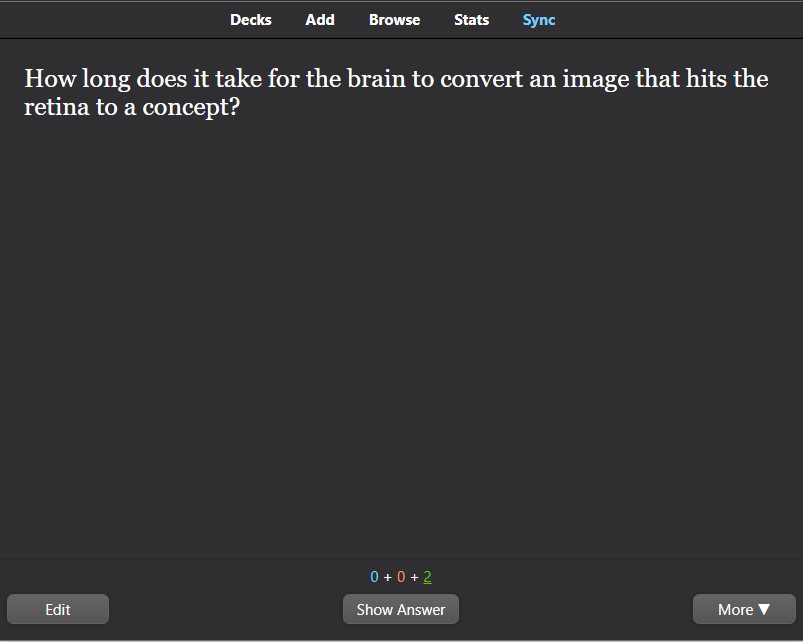
And an answer. Like so:
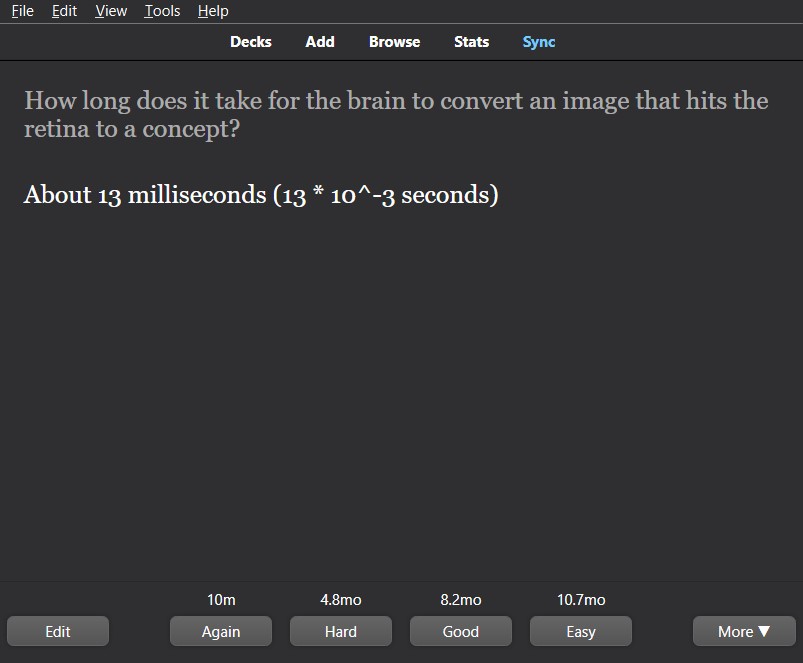
The above images were grabbed from my review session days ago. Depending on how easy it was to recall an answer, you choose from the Again, Hard, Good, Easy options which specify when next you want to see that question-note. See using anki feedback to make ideas salient
I could go on and give step-by-step instructions on how to create a card, how to create decks (and so on) but that’s ineffective. There is an online Anki manual that documents how to use Anki in detail. What I’d do instead is give principles on how best to create a question/answer note and how best to organize Anki decks. (If interested in reading only parts of the Manual that are immediately useful, see Getting started with Anki - the bare minimum.)
After 1+ year of many organic changes, this is the current look of my Anki decks. It is unlike the deck in a newly installed Anki app. It has become stable for now:
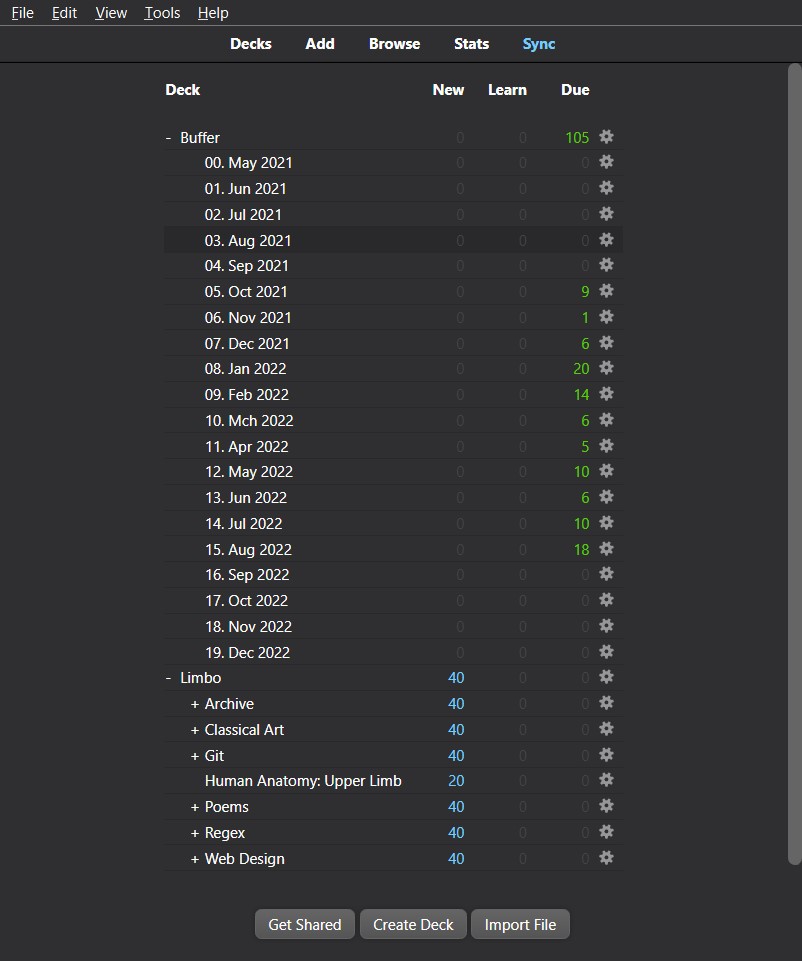
I find that, on one level, separating decks into ‘Buffer’ and ‘Limbo’ helps differentiate the nature of things I’m learning. I named the first ‘Buffer’ because the deck represents the group of notes I made for things I’m currently learning. ‘Limbo’ on the other hand represents the group of things I plan on—but haven’t started—learning. The separation is important because Anki (and other space repetition softwares) are essentially a stream of urgent todos. It is a stream because the various notes in the Buffer deck are always systematically moved into my attention-space. But if there are “notes/courses” you plan learning but don’t have the time for yet, then they should go into Limbo. Limbo is where nothing happens. The notes there are not in my attention space yet. See SRS is not a bucket SRS is a pipe.
The subdecks in the Buffer deck are separated by months because that way, I can decide to focus on just the notes I created when I learnt a specific thing for that month. It is also like a journal. I can reimagine the headspace I was in that month. See how should anki decks be organized.
Principles for thinking about Anki and other SRS systems
- Anki use is a skill
- Anki helps you plant a thought
- Anki as catalyst for habitual thought
- Anki as stream of urgent todos
- Anki is not a bucket, it is a pipe
- Anki as hook for scaling steep learning curves
- Anki as journal
- Anki as a liquid library
- Review sessions with Anki should be creative sessions
- Anki helps move from an old thought to a recent thought so that moving from a recent thought to an old one becomes easier
- In my review session today (29th August 2022), I was shown a particular note for a concept I had been thinking about. I created the note on the 7th of July 2022. This was before I had a conversation around the topic of the note with a friend recently—August 27th 2022. My mind did not think about the note when we had the conversation. I guess the note had been infrequent during my review sessions. But on seeing the note today, and meditating on it, my mind was reminded of the conversation I had had with my friend. This is basically a kind of serendipity, a salience of ideas—Anki fosters serendipitous living.
- In this case, the old thought is actually old because it was “ankified”.
Principles for writing good Anki notes
See A gallery of various personal notes
- a note should be atomic (focused or atomic)
- a note should not be vague
- a note should be tractable
- a note should be effortful
- make many fleeting notes
- tag your notes by topic
- a note should contain images where possible
- create notes when you must (Don’t learn it if you do not [want to] understand it)
- refactor or delete notes that are big or stale
3. Attempts at using Anki for various information media
Using Anki to think about algorithm design problems
This was the first thing I really pointed Anki at, and the hardest. The aim was never to cram code but to keep the thought process toward a solution within reach: the problem statement (compressed into my own words), the constraints, the shape of the approach, so that a new problem reminds me of a related one. The prompt itself kept evolving over the years (“design an algorithm that…”, then “restate the problem in your own words”, then “how many sections of code are in the solution”), and a lot of the work was fighting Anki’s scheduler to surface only a handful of problems a day instead of drowning in reviews.
Using Anki to read the bitcoin paper
The Bitcoin whitepaper is short but dense, the kind of document where every sentence rests on the one before it: hashing, proof-of-work, the longest-chain rule, the double-spend problem. Reading it once leaves you with a vague glow and no real grip. I broke it into prompts, roughly one idea per card, and let review turn that glow into something I could actually reconstruct and reason from. It became the seed of a much larger blockchain-and-money deck.
Using Anki to learn a course
My test case for “learning a course” was Robert Shiller’s Financial Markets (his open Yale lectures), which I took in 2021. Courses are where my old failure mode lived: I have a long graveyard of half-finished Coursera and Udacity courses I abandoned the moment the schedule got inconvenient. Ankifying the key ideas as I went was the first time the material outlived the lectures, and it fed a string of related notes (Shiller’s argument that prices are far more volatile than fundamentals justify, Narrative Economics, Animal Spirits).
Using Anki to remember movies
I don’t try to memorise a film frame by frame. I want to hold its plot, its setting, and the way it made me feel, so I can talk about it as if I’d watched it yesterday and use its images as a shared language with other people. A handful of cards per film (character, place, the turns of the plot) is enough to keep the whole thing warm.
Using Anki to master exercises and movement
This is the clearest case of a card that asks for an action rather than a fact. A note can hold the question “what muscle group does this movement train”, but it can equally be a recurring prompt to actually do the push-ups, the pull-ups, or a mobility drill. The rating becomes a log of how the body felt rather than how well I recalled something.
Using Anki to read books
A book read without any retrieval mostly evaporates: a month later you keep the mood and lose the argument. The move is to make a small number of good prompts per chapter, not a card for every fact (which is how you learn to hate both the book and Anki), so the spine of the book stays recallable long after you’ve shelved it.
Using Anki to read articles
Articles are a natural unit for this, short enough to digest in a sitting and dense enough to be worth keeping. The danger is volume: it is easy to ankify everything you read and bury yourself. So I treat it as triage, where only the few claims or facts I actually want to carry forward become cards.
Using Anki to learn history
History is almost designed for spaced repetition: dates, sequences, who did what to whom, the causal chains you only really grasp once the names and the order are automatic. Anki handles the scaffolding (the timeline, the cast) so that attention is freed for the interpretation, which is the part that actually interests me.
Using Anki to learn novels/stories
This sits close to the movies section. With fiction, what I want to keep is not facts but texture: the characters, the shape of the plot, a few lines or images worth carrying. The risk is killing the thing you love by over-instrumenting it, so the cards stay light, just enough to keep the story from fading entirely.
Using Anki to learn a language
After the algorithm-design work, this is where I’ve leaned on Anki the hardest. A language is almost pure memory work at the start, exactly the shape of problem spaced repetition was built for. I work through the kanji with Heisig, then explode a beginner podcast (and whole films) into one sentence-card per line, audio and kanji links attached.
Using Anki to watch youtube videos
A “watch later” playlist has the same problem as a stack of unread books: it just sits there. So I import an educational channel or playlist as cards and let Anki schedule the watching and the re-checking. The knowledge isn’t what’s being stored; the attention is.
Using Anki to learn drawing
More aspiration than practice so far. But the principle holds: a card can prompt an action, not just a fact. Anki is great at the recognition vocabulary of drawing (perspective, proportion, how light falls) and can only schedule, not teach, the hand-eye motor skill.
Using Anki to learn music
Music splits along the same fault line as language and drawing. The memorisable half is large (note-reading, intervals, chords, ear training) and fits Anki perfectly. The physical half, actually playing, Anki can only put on a recurring schedule.
4. Conclusions
- What was my initial want/hope for my SRS system with Anki?
- Did I achieve that want?
- One thing I wanted to achieve was to be able to think about a good number of chunked information simultaneously so that I could easily draw-out relationships between the various information.
- So that, for example, when one thinks about coming up with a solution for an algorithm design problem, you are easily reminded of similar problems and an idea for a solution becomes close at hand.
- E.g., it will be nice to be able to easily see how solutions to the following problems on binary trees are related. Doing this involves being able to think about the chunked detail of each solution simultaneously:
- Given binary tree determine if there is a path with nodes that sum to a target number.
- Given binary search tree, determine if a target exists in one of the nodes and return that node.
- Given preorder traversal of BST in an array, return a root to the constructed BST
- Given root of binary tree, return its diameter.
- Given root of binary tree, return a root to the inverted binary tree.
- Given the root of a binary tree, return its maximum depth.
- I also wanted the things I was learning to become a part of me, integral to my personality.
- Well, now I know that there is an important difference between recall and speed of recall. I initially hoped that using Anki could help me not just “remember” things but also remember things fast. Perhaps a better word is recall. I wanted to be able to recall things fast. So that I could look at, say, the title of a leetcode question and quickly remember what was being asked and the various solutions that can be implemented. And a test of “quickly remembering” is if I can state the problem out loud fluently without having to think too hard—i.e., trying to reimagine what the problem and solution must’ve been about.
- Yes, there were a few successes, but I find that this ‘speed of recall’ is probably difficult to improve? It seems like it’s an inherent quality of your natural memory? I’m not so sure.
- One thing I wanted to achieve was to be able to think about a good number of chunked information simultaneously so that I could easily draw-out relationships between the various information.
- It is also sometimes difficult to keep up with the daily work that has to go into review sessions especially when you are busy with other things. This makes you lazy. So, you don’t use Anki to fulfill its function. See Anki Laziness
- what is the opportunity cost of incorporating anki review sessions into your daily life? (what have i unconsciously lost by using anki?)
5. Miscellaneous notes
- Getting started with Anki - the bare minimum
- promised benefits of SRS systems
- useful for programmers and knowledge workers
- knowledge can accrete and you can learn more and become more productive Richard Hamming: “What Bode was saying was this: “Knowledge and productivity are like compound interest.” Given two people of approximately the same ability and one person who works 10% more than the other, the latter will more than twice outproduce the former. The more you know, the more you learn; the more you learn, the more you can do; the more you can do, the more the opportunity - it is very much like compound interest. I don’t want to give you a rate, but it is a very high rate. Given two people with exactly the same ability, the one person who manages day in and day out to get in one more hour of thinking will be tremendously more productive over a lifetime. I took Bode’s remark to heart; I spent a good deal more of my time for some years trying to work a bit harder and I found, in fact, I could get more work done.”
- Anki vs. Readwise
- Anki laziness
- interacting with anki automatically schedules the hierarchy of difficulty when learning a linear course
- create notes in anki first before refactoring them into obsidian when doing light/new research
- create notes in obsidian first before refactoring them into anki when doing heavy/old research
- “what will i be doing without anki? like. how will i actively keep track of thoughts??“
6. Philosophying
- Is infinite memory desirable?
- Is long-term memory desirable? What even are the benefits?
- Can a case be made for forgetting?
- Can a case be made for forgetfulness?
- What might the future of SRS systems look like?